JOIN OUR WHATSAPP CHANNEL










































EXCLUSIVE: 'Lata Mangeshkar was my guru, you can never compete with your Guru' says Anuradha Paudwal
Singer Anuradha Paudwal says she shared a ‘spiritual’ connection with the legendary Lata Mangeshkar.




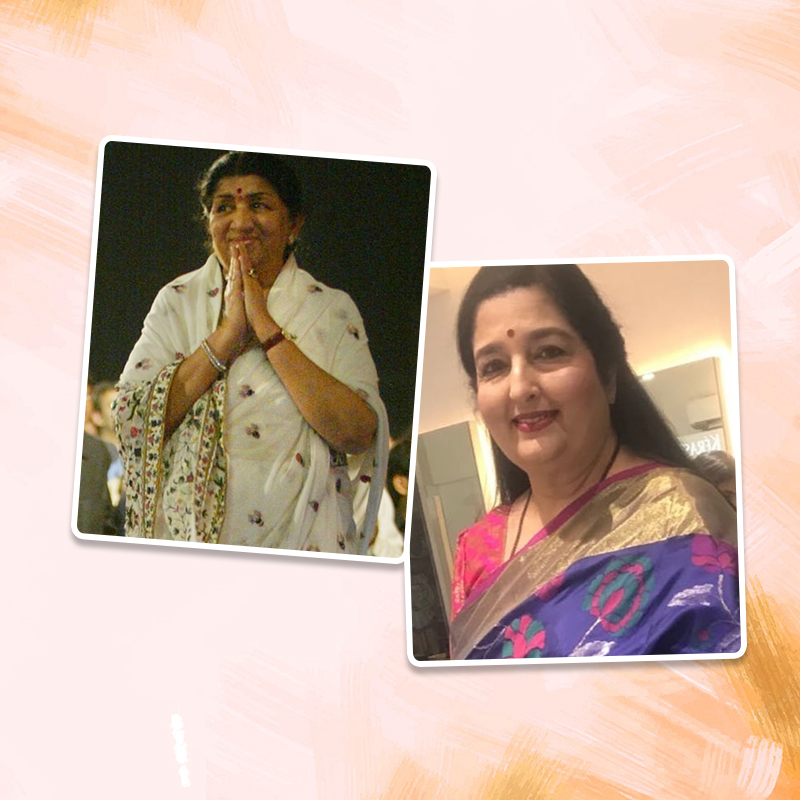
Her relationship with the late Lata Mangeshkar defies definition. Anuradha Paudwal may have met Lata only a few times. But the legendary singer’s impact on her life and art has been surreal. Like the time when a nine-year-old Anuradha (she was known as Alka Nadkarni then) witnessed Lata’s ‘live’ recording in a studio spellbound. Or when a bedridden Anuradha convalesced listening to Lata’s Bhagwat Geeta and reinvented her voice in the bargain. Or when she reverently picked up the paper that Lata had left behind after recording a Marathi song and sang it herself on a radio show.
The fact that Anuradha’s career took a jumpstart, after her rendering of the Shiv stuti in Abhimaan, also has a Lata factor. Originally to be rendered by Lata, the dubbing of the shlok by Anuradha was retained by S.D.Burman almost in a divine twist. While Anuradha has had her own impressive trajectory since, Lata remained in her life as a Guru – her daily riyaaz comprising the Nightingale’s rendition of the Geeta. Way beyond allegations of monopoly and machinations, Anuradha maintains that hers was a spiritual relationship with Lata… someone she didn’t have to meet ‘ru-ba-ru’ (in person) but who mirrors in her music.
Excerpts from our chat with her:
What’s your first memory of Lata Mangeshkar?
Music is not something that was encouraged in my family. But as a little girl, whenever I heard Lataji’s voice on the radio, it left me fascinated. I’d tell everyone that I wanted to hear her sing live. I was nine when my dream came true. A common friend, producer PN Arora, took me for Lataji’s recording at Famous Studio. S D Burman da and RD Burman were both in the music room. She was singing a song, Poocho Zara Kaise, for Burmanda. I sat there for hours listening to her with a rose in my hands. I was spellbound. I couldn’t believe that anyone could possess such a voice. It seemed straight from heaven. It was hypnotising. I thought if one has to sing then this should be the voice. As a child, my voice was hoarse. After hearing Lataji’s voice, it seemed alien to me. This one experience was enough to last a lifetime.
What then made you take to singing?
As a young girl, I fell ill with pneumonia once. I lost my voice completely. During that time Lataji’s record titled, Lata Recites Bhagwat Geeta, was released to commemorate her 25 years in cinema. I had even attended the function at Rang Bhavan. Being confined to bed, I spent my days listening to Lataji’s Bhagwat Geeta. This went on for 40 days. By then I had learnt the verses by heart. So, I started singing along with her. Before I realised it, my voice had changed completely. It was a transformational experience. Till date I do my riyaaz with Lataji’s Bhagwat Geeta. Obsessed with music, when I was in class nine, I took up a job in a cassette shop in Bandra, just to be able to listen to Lataji all day long.
How did your singing career begin?
The atmosphere at home didn’t favour me joining the industry. So, I remained focused on singing ghazals and Meera bhajans. I’d listen to every new record of Lataji. I trained my voice by listening to her songs. Once I came to know that Lataji was going to be recording a non-film Marathi song, Paha takale pusuni dole, for the jawans. My husband Arunji (Paudwal) was conducting the music for Hridaynath Mangeshkarji. I attended the recording session and listened to Lataji attentively. After the recording was over, she left behind the paper on which the song was written. I picked it up and brought it home.
By chance, I was called to sing a non-film song for the Yuv Vani on All India Radio
I chose to sing Paha Takale Pusuni Dole. As luck would have it, the song was heard by music composers like Laxmikantji, (of Laxmikant-Pyarelal), Bappida and even Hridaynathji. He called up the radio station and said, “We recorded this song just a few days ago. How did you release it?” They said, it’s not the one sung by Lata Mangeshkar. It was sung by Arunji’s wife. Soon enough, Laxmikantji, Bappida... called up to offer singing assignments. But I was not interested in singing for films.
The stuti you sang in Abhimaan (1973) was to be sung by Lata. Right?
Arunji was arranging the music for Burmanda for Abhimaan. Burmanda needed a Shiv stuti for Jaya Bhaduri’s introductory scene shot around a mandir. Arunji composed the stuti and asked me to ‘dummy’ sing it. He recorded it on a tape recorder at home and took it to Burmanda. When Burmanda heard it, he was surprised that I had sung it. He retained it saying, ‘Why give Lataji trouble for such a small clip’. That was the turning point of my life. After this shlok, I received many offers to do playback. Within 10 days, I sang for all of the music directors who’d approached me earlier. I wanted to seek Lataji’s aashirwad before I sang my first film song for Jaidevji. Arunji took me to meet her. She was extremely sweet and gentle and wished me warmly. The song didn’t release but later I did the playback for Jaidevji’s Dooriyan (1979).
Was it an uphill task to make a mark considering that Lata Mangeshkar and Asha Bhosle had a formidable presence on the music scene?
Contrary to what people say, at no point in my life was I ambitious. My father would say girls from good families don’t sing in the industry. I wanted to be a doctor. When I had no ambition, then where was the struggle? I only had gratitude for whatever came my way. Lataji is my Guru. A Guru is only to be revered. You can never compete with your Guru.
Much has been written about the monopoly of the Mangeshkar sisters…
I don’t believe it was about monopoly. Let me put it this way. One person has reached Mount Everest. For those who can’t even climb a hill, it’s easy to say unhonon hamein chadne nahi diya (they didn’t let us climb). If you have talent, at least begin the climb. Lataji set such a high standard. Ishwar ne unhein nawaza tha. The way Lataji delivered was brilliant. Several music directors could realize the dreams they had envisioned for themselves through her beautiful voice. Musicians didn’t have to work hard on Lataji or Ashaji. They were so perfect. The songs were superhit from the word go. Naturally, their first preference was Lataji and Ashaji.
How did you get into mainstream singing?
I was asked to do the dummy singing for Satyam Shivam Sundaram (1978), while Lataji was to record the song later. I didn’t want to do it. I feared my image of a ‘dummy singer’ would remain in Raj Kapoor saab’s mind. But with time, dummy recordings began being retained in the soundtracks. Laxmikant-Pyarelal was to compose the music for Subhash Ghai’s Hero (1983). I told Laxmikantji that I’d like to ‘dub’ the mahurat song. He clearly told me that it would be sung by Lataji finally. But I wanted to give it a shot and try my luck, hoping it would be retained. I sang Tu mera jaanu hai. Those who heard the song believed that since the film was introducing a new boy (Jackie Shroff) and a new girl (Meenakshi Sheshadhri), the new voices (Manhar Udhas’ and mine) should be retained. The next song we dubbed for was Ding dong baby sing a song. That was also retained. This was my first major breakthrough.
Unprecedented fame came to you after you collaborated with Late Gulshan Kumar of T-Series in the ’90s …
When I began singing for T-series, Gulshanji said, ‘I will promote your songs but you will sing exclusively for us’. We came out with non-film albums like Lal Dupatta Malmal Ka (1989) and many others. Every album had 10 songs and all were well promoted. People saw my face on the cassettes, in videos and heard me consistently. They associated my face with my voice. Success comes to you when it’s destined. So, it was not about the alleged ‘monopoly’. It was about the right things happening at the right time. Time is the ultimate.
Were you nervous when you reprised Lata’s songs for T-Series?
I told Gulshan ji that some of Lataji’s songs, composed by stalwarts like Madan Mohanji, Shankar-Jaikishanji…, were extremely close to my heart. I wanted to sing these as a tribute to my favourite artistes.They were not ‘versions’. They’re more pujniya (sacred) to me than my own songs. I had to sound very very close to the original renditions to maintain the sanctity. It was not that I could introduce harkats or take liberties here and there. I worked harder on these songs than on my own. A composer pours his soul to create a composition that’s advitya (unparalleled). At least, we should not mess with it. I recorded the songs with extreme reverence towards Lataji. It was not to prove anything. I have worshipped her like Maa Saraswati. Saraswati is vaani (awaaz) and for me Lataji is Saraswati. She is with me today and every day. It’s been a spiritual relationship… suron ka rishta.
What was her hallmark as a singer?
Kalyanji of Kalyanji-Anandji once said something beautiful about Lataji. That she’s extremely knowledgeable but has never betrayed a I-know-it-all attitude. ‘Main seekhi hui hoon’ yeh attitude unmein nahi tha. She never took an extra ‘sur’. There’s surrender, there’s humility in her songs. No dikhawa (show-off). Her singing was so powerful, she didn’t need to create any drama. She just had to come and stand and everyone was spellbound. Her voice was so pristine. Her song Bangle ke peeche kaanta laga (Samadhi 1972) … has been remixed a number of times. On hearing it, she’s known to have said that she felt ‘ashamed’ to say that she had sung it. I would not like to remember that bodily she’s not there. Even for a moment, if you remove Lataji from Bollywood it will be a khaali dabba. When Lataji passed away, people said it was the end of an era. But she was not an era, which can end. Her music is immortal.